
If you’ve been fighting an insurance company for a diminished value claim after a car wreck, you might eventually receive a letter that feels surprisingly polite. Instead of a harsh, flat-out denial, it reads like they are doing you a massive favor.
Don’t be fooled. This is a classic insurance tactic designed to make a terrible offer look like an act of charity.
Let’s take a look at a real-world example to see exactly how this play works and why you shouldn’t fall for it.
The Setup: “We’re Doing You a Favor”
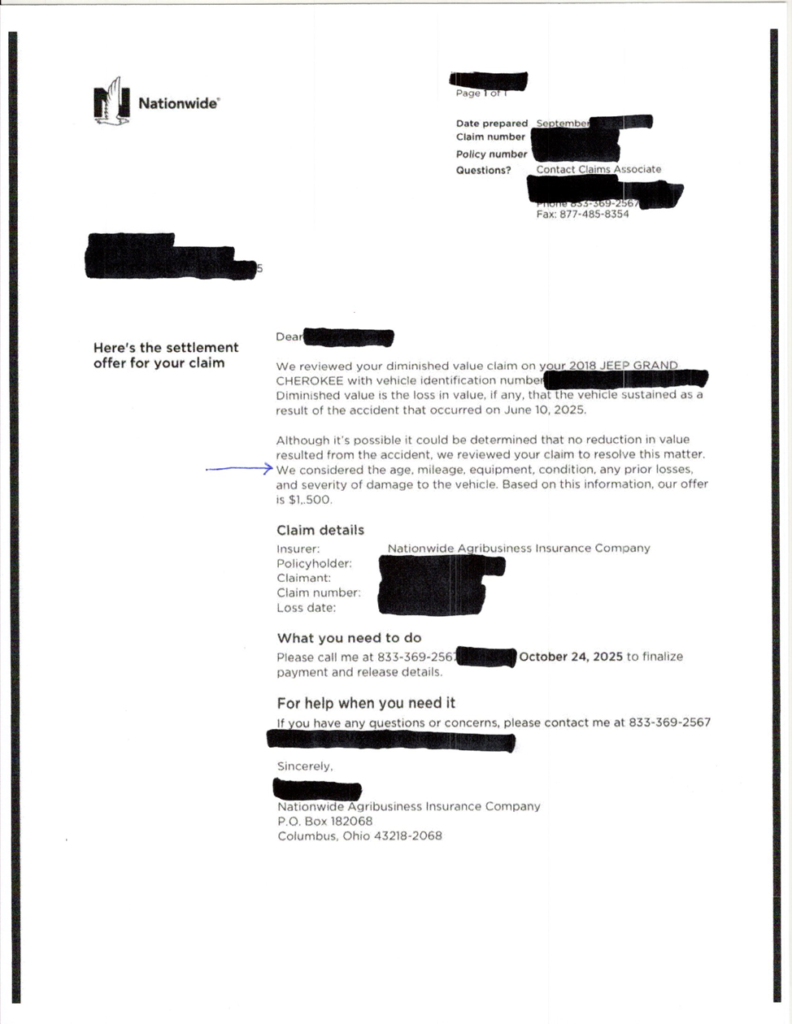
In the document seen here, Nationwide reviews a diminished value claim for a 2018 Jeep Grand Cherokee. Look closely at the language they use right before they name their price:
“Although it’s possible it could be determined that no reduction in value resulted from the accident, we reviewed your claim to resolve this matter. We considered the age, mileage, equipment, condition, any prior losses, and severity of damage to the vehicle. Based on this information, our offer is $1,500.”
Let’s break down the psychological framing happening here:
- The Guardrail: They start by planting a seed of doubt: “Hey, we could easily argue your car lost zero value.” This is meant to make you feel like your claim is weak or that you’re lucky to get anything at all.
- The Benevolent Reviewer: “…but we reviewed your claim anyway to resolve this matter.” Translation: We are the good guys here. We want to help you settle this easily.
- The “Trust Our Math” Formula: They list a generic string of variables – age, mileage, equipment, condition, severity – to make it look like a highly scientific, customized calculation.
Then comes the punchline: An offer of $1,500.
Why a $1,500 Offer is Way Undervalued
For a modern SUV like a Jeep Grand Cherokee, a $1,500 offer is often a massive lowball. It is a “nuisance payment” – an amount high enough to tempt you into walking away, but drastically lower than the actual economic damage your vehicle just sustained.
Here is what Nationwide isn’t telling you in that letter:
- The “Stigma” is Real: Even perfectly repaired, a vehicle with a significant accident history takes a massive hit on the open market. Dealerships will instantly slash thousands off your trade-in value the second they run the CARFAX.
- Generic Checklists Don’t Equal Market Reality: Listing “age and mileage” doesn’t mean they actually checked what local buyers are paying for a wrecked vs. clean-title Jeep. They are using internal formulas designed to protect their bottom line, not your equity.
- The Deadline Pressure: Notice how they give a tight deadline to “finalize payment and release details”? They want you to sign away your rights quickly before you have a chance to talk to an expert and realize how much money you are leaving on the table.
Don’t Settle for the “Good Guy” Routine
When an insurance company acts like they are doing you a favor by offering you a fraction of what you owe, remember: they are a business trying to minimize a payout. A polite lowball is still a lowball.
If you accept that $1,500 and sign their release, you can never go back for more, even if you lose $5,000 when you eventually try to trade the car in.
Get a Real Evaluation
You don’t have to guess what your inherent diminished value actually is, and you don’t have to accept a generic formula. If you received a letter similar to this one, let’s take a real look at your vehicle’s actual market loss.
Don’t let polite language trick you into losing thousands. Contact my office today, and let’s hold them accountable for the true value of your vehicle.